
The Adaptable Man
a novel by Janet Frame

Humans are adaptable. It’s how we have survived—evolved, pretty much, for the most part, successfully, for now. Who knows how long we will last? It could go on for a long, long time, or all end badly. One big asteroid could screw us all—or just bomb the fuck out of ourselves over disagreeable ideology shit. When it comes down to it—it doesn’t matter a hill of beans in this crazy world, the universe, or whatever; everything will go on with or without us.
But I digress just because of the times in which we live right now—which seems to reinvent itself with every generation—and with every generation comes a change in the form of progress, being adaptable is necessary. There is always a population that winds up marginalized by progress, whether it is age, poverty, a way of life, location, and such—strings are being pulled by the connected and wealthy, never giving any thought about the impact that leaves people behind because they cannot keep up and they become victims of their circumstances. There are very powerful people in this world who have a plan for the rest of us. There may come a time when the marginalized are thought of as rats with shoes—a terrible thought, isn’t it? Yes. Do I believe this could happen? I hope not. Writers and artists go to these places and peek around the darkest corners to see what’s there—it’s unnerving to see the writing on the wall.
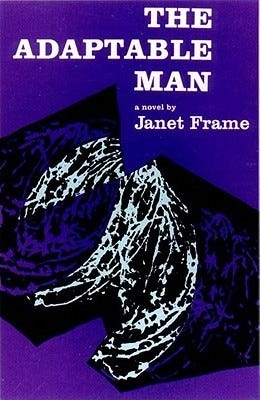
This brings us to Janet Frame’s novel The Adaptable Man, the village of Little Burgelstatham (…a burger, a burial place for the heathen. p. 12.) What happens there, and the people who live there.
Botti Julio, an Italian farmworker (and a survivor of a concentration camp) arrives in Little Burgelstatham one evening; on the way to the Sapley’s farm, where he has a job picking black currents, he dies, found drowned in a pond the next morning… well, only the scarecrows saw what happened to Botti Julio. (Page 19.) The blame falls on the lack of electricity to light Murston Lane; the poor man couldn’t find his way in the dark and didn’t know there was a pond—he was a stranger, he was foreign, and his English wasn’t very good. What was officially determined to be an accident was actually a murder. But why was he murdered? Was it because he was a stranger? Or was there some other reason? Who killed him? Why? Why on earth would the Sapley hire a man to come all the way from Italy to pick black currants for them when there are perfectly capable people who live here who will happily do the job? This man died by the hand of another, and there is no justice served. The killer gets away with it—he’s a real piece of work, that one...argh, what the fuck, dude! It’s been a while since a book made me flinch and squirm a bit. There are some things I’m not going to cover here—I could go on a long rant about this asshole, but it wouldn’t be productive, so I won’t. If there’s anyone else out there who wants to take an intelligent and well-researched psychoanalysis crack at it, be my guest.
The ghostly memory of this man’s death lingers through the thoughts of the varied cast of characters, including Alwyn, the murderer (which isn’t a spoiler because it’s right on the back cover as the synopsis). He muses on page 113 I’m no Raskolnikov. (Nice touch!) It seems that some of the characters know or suspect who killed him, and/or may have witnessed the act, or just perceptive enough to put 2 + 2 together and think—“Maybe…” (But don’t we all rather not think the worst of someone? Especially when they’re handsome and bright and a family member?)
Botti Julio’s ghost lingers throughout the book, echoes of his learned phrases flit here and there just when you might have forgotten—What? You didn’t know this was a ghost story? In the traditional sense of a ghost story, it wouldn’t be, but it is—on page 20, the ghost is first mentioned:
…see—here, now, a ghost in our story…
Oh, a haunting we will go, a haunting we will go—Boo! Scream! A haunting we will go! (Now I’m being silly, I’ve been tipping a little bit o’ our mead tonight while Winter Storm Stella is raging outside so this might be a little more amusing or not...) Anyway—an author who ventures beyond the parameters of expectation is one after my heart.
One of the many things I love about Janet Frame's novels is that they are more than they seem. On a whim one morning, I dug around the Internet to see if someone had written something interesting about her books (someone usually does), and I found an essay: An Other Form of Ghost Story by Josephine Carter (link at the end). It’s a fascinating essay overall, but I only wish to quote from it here: “Critical of all state legitimized violence, Frame, a literary agitator, enacts a disruptive response: an unconventional ghost story which denies closure and the reestablishment of order.” The “spine-tingling” in this “Other Form of Ghost Story” is not about the ghost jumping out, saying “boo!” to scare the jeepers-creepers out of a body to get revenge. It’s about the persistent sense of no reprieve; this man’s death will forever haunt Little Burgelstatham—even if it doesn’t create a guilty conscience for the arrogant jerk who did the deed—this man’s death lingers in the atmosphere because “this sort of thing doesn’t happen around here.”
In my view of such things as the ghosts that haunt us, it’s more than the paranormal; it’s the history that the community itself lives with that haunts them. Their traditions, their way of living, doing, everything about them down to the clothes they wear and the food they eat, their routines in everyday life, the fields of barley and sugar beets. The outside world is invading their homes through modern conveniences like electricity and the improvement of transportation by upgrading the roads. Early on in the novel (page 34), Bert Whattling, a 74-year-old pensioner riding his bicycle, feels intimidated by the traffic— It was no help for Bert, facing the hazards of fifty yards of A-class road, to remember that he’d once been a soldier, in the First World War. Danger seemed not as simple as it used to be.
Then there’s information and entertainment more readily available through television (again, Bert’s perspective later in the book, he laments on page 232 “A television breed!”
The final nail in the coffin of this small community comes in the form of the migration of people from London, “the Overspill.” Poor Bert, near the end of the book, can’t even catch his breath in a favorite spot against the old Unwin family cottage wall facing the lilac hedge because the owner of the cottage has fenced it off, effectively barring him from settling himself down to take a load off after eating his lunch. Then, on page 223, he suffers the indignity of the “television man from London” calling out to him, “Whattling, here a minute!” Bert was always just Bert to those who knew him, and so… he [the television man from London] had committed the double crime of imagining that he already belonged to the village and that he could speak to Bert as a master might speak to his slave.
(Sigh.) Take a breath, there’s more…
The Overspill is coming like a plague of locusts. This book is from 1965—the Baby Boomer generation (which I’m part of—I’m one of the bookends of that generation; sort of a hybrid with GenX) and the post-WWII life, a society in motion, and the mandated consequence branded as “The Overspill” of Londoners to the quiet little hamlets and villages in the countryside. The Overspill is otherwise known as Suburban Sprawl in America. I grew up in a neighborhood that was built in the 1950s by some of the GIs who came home from the war. The one-story ranch houses were fitted into neat little sections butted up against older homes that had once been the grand homes from another time. Their original property lines cut and cut again, parceled out, bit by bit until it’s just an odd-shaped lot on which a rather large house lounge, the lone proud lion surrounded by domestic cats. My mother, who grew up in that small town, remembered our neighborhood as farmland; the street had once been a horse-drawn wagon track into the woods. The town was changing, the economy was changing, and business that had once been the boom of the town was dying out with the slow demise of the generations that had built it. The new generation commuted to The City to work. It was a nice town to raise a family. Through the 1970s, I watched out of the corner of my eye as the town evolved into something other than what it once was; the old homes themselves became parceled into apartments, and some neighborhoods that were once very nice became rundown and sad. The once grand homes sagged and leaned; their facades furrowed with age. I moved to the city to go to college and then started my family there, but later, we moved to the country to get away from the problems of the city, the crime, the filth, and the schools. We followed our dreams to an old farmhouse on an acre of land, which was surrounded by fields being farmed by local people who were renting from the current owner. The house was the classic fixer-upper (money pit.) The land and house had once been part of the farm, subdivided, and sold off piecemeal. And now, twenty years later, the “overspill” is happening, bordering on my backyard. There was a time when our house before we owned it, was the only one on Irish Hill, but things changed. People live and die, move on, and adapt to do something else other than farming. Now, our old farmhouse is the sore thumb compared to the newly built homes that arrived made to order, pre-fab, delivered on the back of trucks; each section pieced together. It’s a difficult transition getting used to the sounds of their being there. Now we’re the oddity—we’re those people. I am irritated by the encroachment, we were here first—with that said, I felt sympathy for the residents of Little Burgelstatham—they’re becoming the ghosts of a time and way of life fading fast.
(From page 224) An exciting, controversial talking-point, but not nearly so enjoyable now that the idea was becoming a frightful reality... “Overspill. Overspill.”
Such a strange word to choose. Didn’t something that spilled, spill over also? Or were they using “overspill” to try to explain that once the people of London began coming to East Anglia nothing could stop them, there’d never be an end of their spilling, as there’d never be an end of people from London…and all over the new words that motorways brought with them—“bypass,” “flyover,” “flyunder.” …
(From page 232)
Rumors became the tall stories of the hour. “They” were going to pull down all the farm workers’ cottages. “They” would build Council flats in the barley fields, offices with luxury penthouses (for directors) in the sugar-beet fields. If your cottage was not pulled down, then it would be taken under the Compulsory Purchase Order to make room for a motorway. Noise, smoke, smell, crime, no jobs, and a race of strangers who laughed at your dialect and your customs and your clothes and your ignorance of the great world; a nasty television breed.
(From page 234)
The town planner, in the deep chair by the fire, put down his glass and turned to his companion, a London architect.
“See what we’ll have to meet?” he said. “They’re a different race. Talk about New Town loneliness! That reminds me—there’s that competition to name the new town. The psychologists say it should be held locally—you know, let the natives feel they have a share in the project. It pays dividends, overcomes hostility.”
“Wouldn’t you be hostile?”
“I’d shoot the invaders as if they were so many wood pigeons. So be careful. We’re in a foreign land here.”
“Should we try to fraternize?”
“Hell no, not more than usual. Just don’t make the mistake of pointing out a wheat field and exclaiming in your educated accent, ‘What magnificent barley!’”
Infuriating, isn’t it? You bet she meant it. This book is quite deliberate with its message—being adaptable. Each character adapts to something in spite of the unpleasant circumstances they find themselves in—some very strange and some very familiar. Alwyn reasons that he’s an adaptable man—able to adapt to being a child of his time after killing a man, a stranger, for no reason. He was just there. There is no need to scratch too deep into their surface to find the itch they worry over, the weather, the overspill, longing for something lost, and the lingering ghost of Botti Julio. “These photographs are underexposed. Please will you intensify them.”
I love Janet Frame’s work because there’s so much more below the surface of the story—it’s more than a story. I “get her.” She’s not an easy read; she presents readers with puzzles and scatters the pieces for us to fit together—I take my time, examine the bits—ooo, and ahh over their intricate plots, and dog-ear the pages, and if I have a pencil handy, I make notes, underline, or other marks.
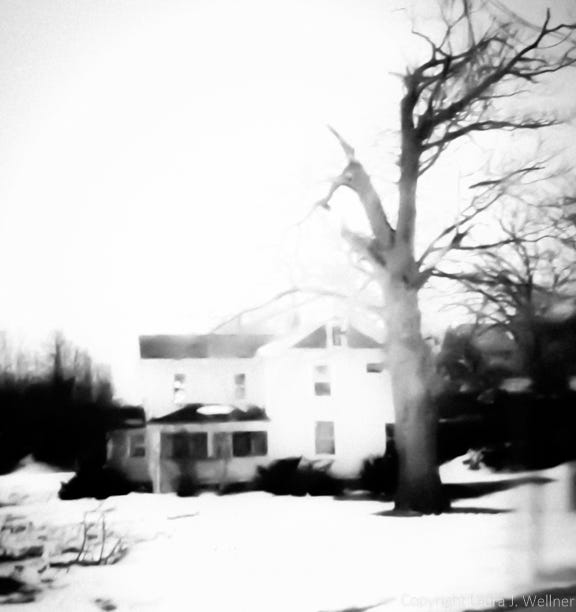
I’ve included a couple of links below: the Josephine Carter link and a link to my WordPress site for a post featuring the photo of the house pictured above. Surprisingly, that old house still stands, boarded up, with the side porch rotted away and torn down. The old oak tree was cut down, as were other trees, and the outbuildings were torn down. It's sadder-looking than ever—it once was a beautiful property, nicely landscaped with flower gardens. It once was a farm, and now it’s in the way of progress, but so far, any plans for the property have fallen through for various reasons. There is so much of that happening these days, too much of that, for comfort.
I want to thank you for visiting and reading—it’s awesome that you’re here. I want to especially thank my subscribers and followers and welcome my new subscribers and followers—I truly appreciate your support—it means a lot to me! Remember to be good to yourselves and be kind to others, okay?
Carter, Josephine. "An Other Form of Ghost Story: Janet Frame's "The Adaptable Man" Interdisciplinary Literary Studies 13, no. 1/2 (2011): 45-60. Link
WordPress website post from 2017, A Victim of Progress, Fading Fast.
Thank you Laura - I loved the way you connect the novel to your experience and overall to the evolution of people and their communities...